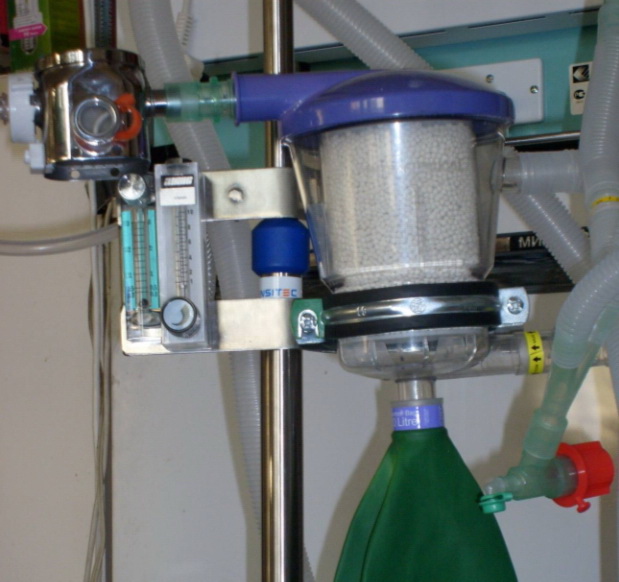
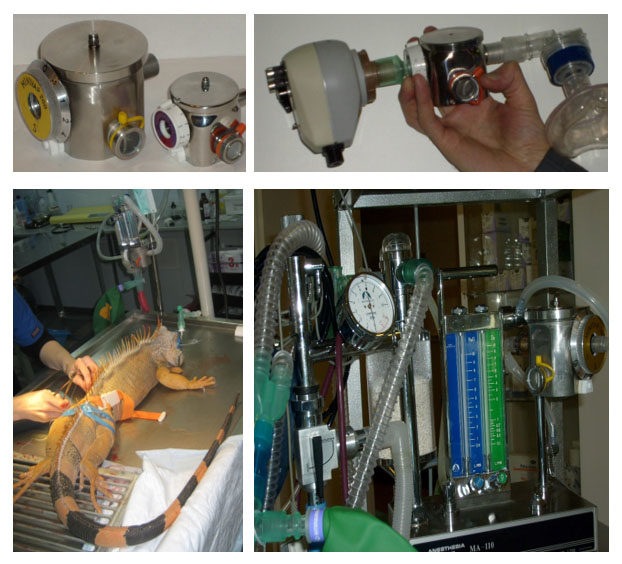
In 2006, prototypes of the new generation of stabilized low-resistance vaporizers, MINIVAP (from the English word “mini vaporizers”), first appeared in Russia. Unlike unstabilized draw-over vaporizers, they are portable, feature a sophisticated thermobaric compensation mechanism, and are capable of accurately dosing anesthetic at gas flows > 0.2 L/min (Fig. 1.5). MINIVAP vaporizers are versatile: installed either inside (VIC) or outside (VOC) the breathing circuit (at the anesthesiologist’s discretion), they can operate with either compressed gas or atmospheric air (oxygenator), using the “one vaporizer for all anesthetics” principle. This distinguishes them from specialized plenum and draw-over vaporizers, which are designed for use with a specific anesthetic agent [4, 6, 7].
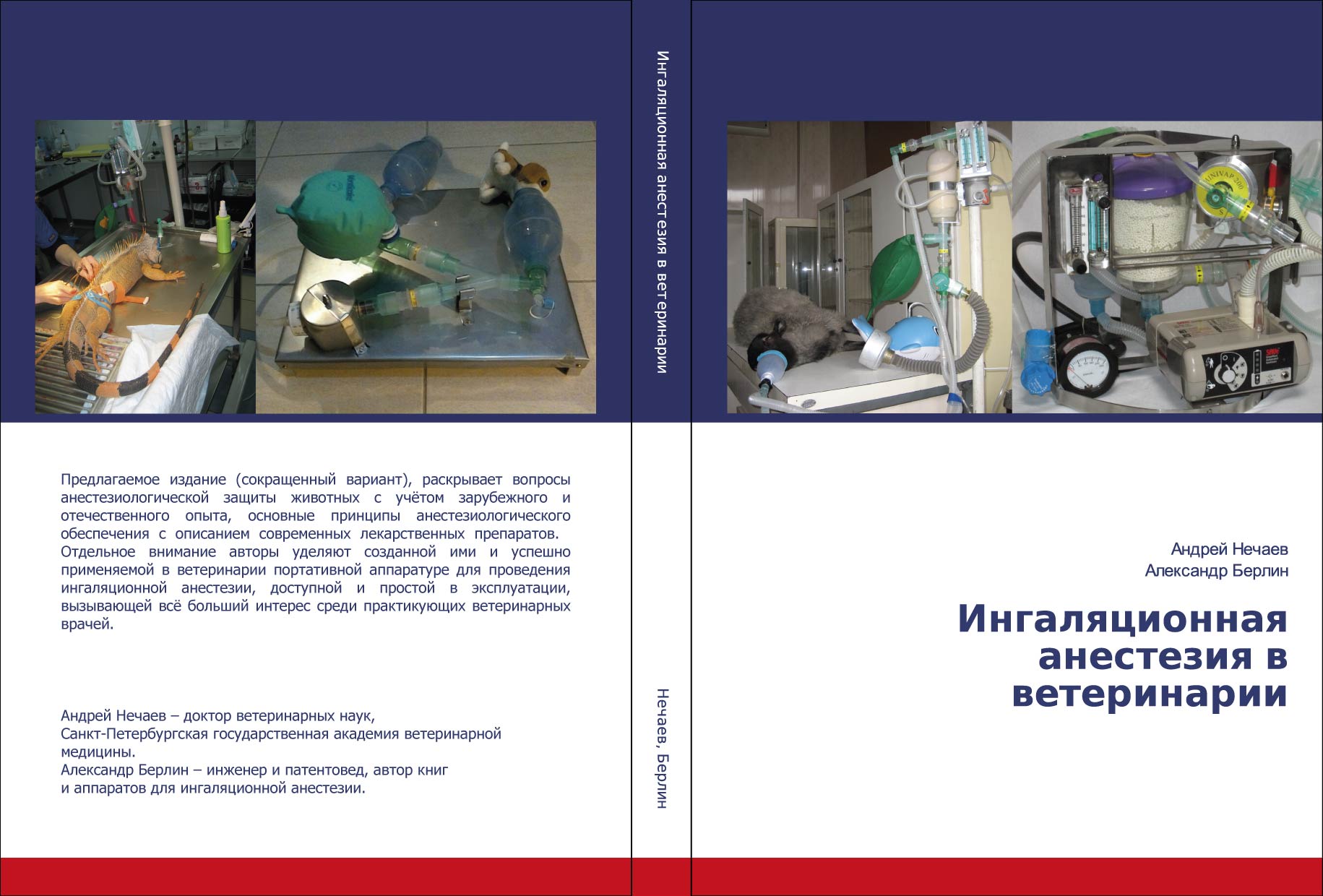
This abridged edition addresses issues of anesthetic protection for animals, taking into account international and domestic experience, the basic principles of anesthetic management, and describes modern anesthetic devices. The authors devote special attention to their own portable inhalation anesthesia equipment, which is successfully used in veterinary medicine and is affordable and easy to use, attracting increasing interest among practicing veterinarians.
Low-Resistant Stabilized Mini-Vaporizers IN and OUT of the Breathing Circuits
A.Z. Berlin L.L. Nikolaev V.A. Sidorov
Manuscript
Low-Resistant Stabilized Mini-Vaporizers IN and OUT of the Breathing Circuits
A.Z. Berlin L.L. Nikolaev V.A. Sidorov
A number of inhalation anesthesia problems (sophisticated and bulky equipment, non-stability of the well-known draw-over vaporizers and delayed change of anesthetic concentration during low- or mini-flow anesthesia) may be solved by using a more advanced vaporizer that would be accurate as a plenum vaporizer, simple and low-resistant as a draw-over one.
Due to the low resistance and virtual independence from fresh gas flow rate, temperature, and ambient pressure, MINIVAP vaporizers are instantly adaptable to needs of both on-site emergency surgery and more sophisticated demands of a general hospital.
A modular format of the MINIVAP Anesthesia Kit give an opportunity of the user to custom-build an anesthetic system (from draw-over to semi-closed) optimally suited to the prevailing situation.
Field conditions
The MINIVAP Anesthesia Kit may be used in military surgery, urgent situations and remote areas, at district hospitals, and in veterinary anesthesia (at spontaneous breath and artificial respiration with air or oxygen, including Oxygen Concentrator; with CO2 absorber).
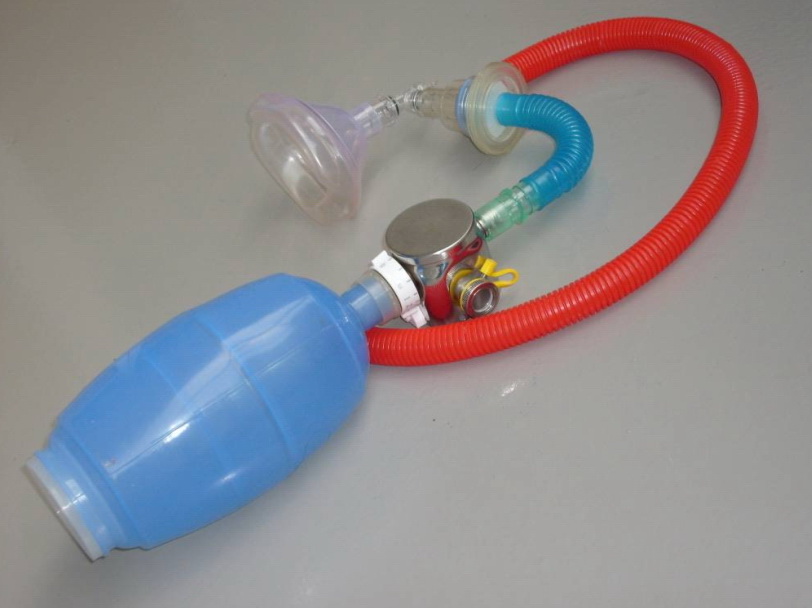
The simplest modification is the pocket vaporizer MINIVAP-20 (MV-20, mass less 0.5 kg) that can be connected directly to a facemask or a tracheal tube by means of a non-rebreathing valve. MV-20 may be used with self-inflating (Ambu) bag or any ventilator and in semi-closed systems during mini- or low-flow anesthesia.
Low-Resistant Stabilized Mini-Vaporizers IN (VIC) and OUT (VOC) of the Breathing Circuits
The main problems related to inhalation anesthesia may be solved by using a more advanced vaporizer that would be accurate as a plenum vaporizer, simple and low-resistant as a draw-over one.
Due to the low resistance and virtual independence from fresh gas flow rate, temperature, and ambient pressure, MINIVAP vaporizers are instantly adaptable to needs of both on-site emergency surgery and more sophisticated demands of a general hospital.
MINIVAP vaporizers have been successfully tested in two leading Moscow hospitals (> 100 anesthesias in adults and children 2-14 years) with different anesthesia machines (Drager Primus, STEPHAN Artec, Datex-Ohmeda S/5 Avance, Ru PMT Xena-010).
A MINIVAP vaporizer may be installed either IN a conventional breathing circuit (instant change of inspired concentration) or OUT of breathing circle (high safety) of any anesthesia machine.
Consumption of a liquid anesthetic by MINIVAP is approximately 5-10 ml/hour at mini or low-flow anesthesia (FG = 0.5-1 L/min) and 1-3 ml in the closed system (during 1- to 5-hour anesthesia).
Low-Resistant Stabilized Mini-Vaporizers IN (VIC) and OUT (VOC) of the Breathing Circuits
I.V. Molchanov V.A. Sidorov L.L. Nikolaev A.Z. Berlin
Manuscript
Use of stabilized mini-vaporizers inside and outside the breathing circuit.
Molchanov I.V., Berlin A.Z., Burov N.E., Gribachev S.V., Korolev A.I.
Clinical Anesthesiology and Resuscitation 2007
№ 5 с. 66-71Molchanov I.V., Berlin A.Z., Burov N.E., Gribachev S.V., Korolev A.I.
Use of stabilized mini-vaporizers inside and outside the breathing circuit.
Molchanov I.V. Berlin A.Z. Burov N.E. Gribachev S.V. Korolev A.I.
Department of Pediatric Surgical Diseases, Russian State Medical University, Moscow Children’s City Clinical Hospital No. 13 named after N. F. Filatov, Moscow Scientific and Production Company “MINIVAP”, Moscow
Inhalational anesthesia in children: stabilized low-resistance mini-vaporizers inside (VIC) and outside (VOC) the breathing circuit.
Mikhelson V. A. Agavelyan E. G. Berlin A.Z. Sidorov V. A. Leshkevich A. I.
Department of Pediatric Surgical Diseases, Russian State Medical University, Moscow Children’s City Clinical Hospital No. 13 named after N. F. Filatov, Moscow Scientific and Production Company “MINIVAP”, Moscow
The article discusses the feasibility, safety, and effectiveness of inhalation anesthesia using a semi-open and semi-closed circuit in children with the use of stabilized low-resistance MINIVAP mini-evaporators installed inside (VIC) and outside (VOC) the breathing circuit.
Brief abstract Inhalation anesthesia: optimal anesthesia regimens and technical support issues. Results of testing and options for using MINIVAP vaporizers in children. Conclusions and recommendations.
Inhalational anesthesia in children: stabilized low-resistance mini-vaporizers inside (VIC) and outside (VOC) the breathing circuit.
Mikhelson V. A. Agavelyan E. G. Berlin A.Z. Sidorov V. A. Leshkevich A. I.
The invention relates to medical technology, specifically to inhalation anesthesia equipment.
Modern inhalation anesthesia devices (Drager, Penlon, Ohmeda) are equipped with precision high-resistance vaporizers (VOC – vaporizers outside the breathing circuit), multifunctional ventilators, and gas analyzers (monitors) for the respiratory gas composition. This results in significant dimensions (weight approximately 50 kg) and cost ($50,000). They are characterized by slow regulation of the respiratory gas composition (inhaled concentration of anesthetic and oxygen) while using economical and environmentally friendly low-flow anesthesia (LFA) [Watney G. In- and out-of-circuit vaporizers. Anesthesia Equipment Resources ASE 2007. www.asevet.com; Baum JA. Low Flow Anesthesia. Drager 2004].
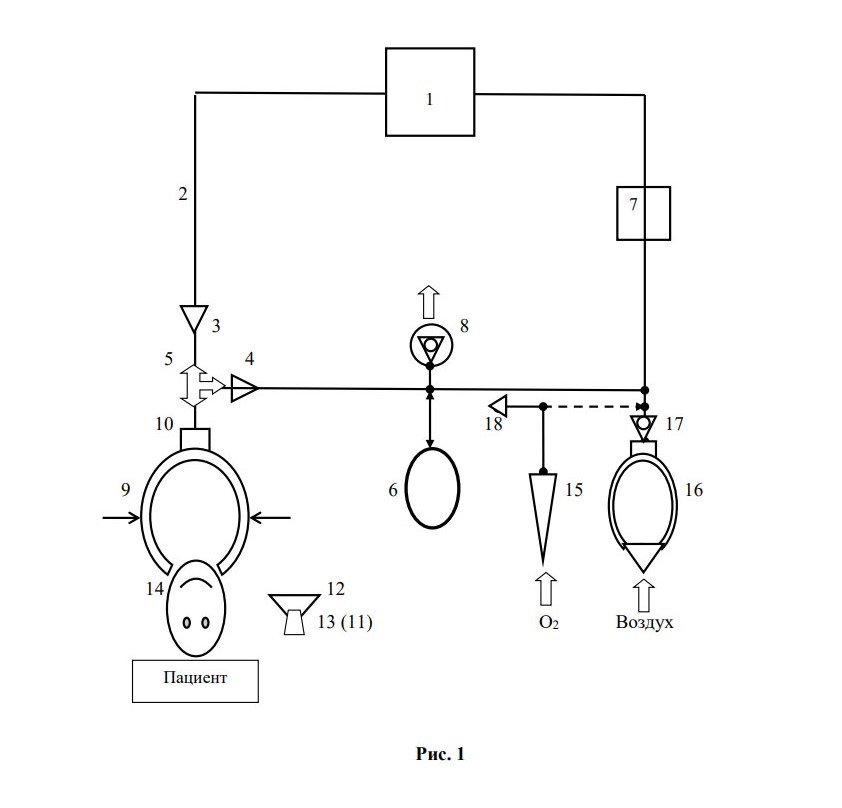
The large volume of the standard breathing circuit of the device (VC ≈ 5 L) during NPA of small patients (up to 5 kg, including various animals) also leads to a significant consumption of expensive anesthetics ($1/ml) and the formation of poorly ventilated zones (according to the Conway formula, the delay T = VC /FO2, where FO2 is the oxygen supply, a multiple of the patient’s metabolic need, for example, 60 ml/min). Thus, only during induction and a twofold change in the isoflurane concentration from 1.5 to 3 vol.%, approximately 10-12 ml of liquid anesthetic is released into the atmosphere. DEVICE AND METHOD FOR INHALATION ANESTHESIA
Mini vaporizers and inhalation anesthesia devices
Alexander Berlin
Abstract
Inhalational anesthesia and equipment minimization to expand its use in emergency situations and uncomfortable environments (emergency medical care, remote regions, military field conditions, man-made disasters, veterinary medicine).
Due to their low resistance and stable anesthetic dosing, the smallest vaporizer, the MINIVAP-20 (300 g titanium for magnetic resonance therapy (MRI)) and the most powerful MINIVAP-200 (up to 12% sevoflurane by volume), provide effective pain relief for adults and children, as well as animals (from mice to horses) in the operating room, outpatient clinic, and during transport.