
Our history
1966
The curtain fell on this three-part story, opened by Semyon Glukhov, the breeder of Alexander Semyonovich Perelmut, the creator of “Soviet” anesthesia and respiratory technology. During the placement of graduates from the Moscow Institute of Chemical Medicine in the spring of 1966, an application was submitted from the All-Russian Research Institute of Medical Instrumentation (then VNIIMIO), and Semyon’s vote was decisive in directing Alexander Berlin in the right direction (not to the Central Research Institute of the Russian Academy of Sciences, as he had dreamed, and not “somewhere far away,” as the Commission threatened).
Alexander Semenovich (a Stalin Prize laureate and one of TsAGI’s leading researchers during the war) assembled a team (probably half of them from the Moscow Institute of Chemical Mechanics), nurtured, and began harvesting a crop of devices:
artificial pulmonary ventilation (Margarita Karlovna Soms, Yuri Samuilovich Galperin), anesthesia (inhalation anesthesia), lung diagnostics (Leonid Ilyich Nemirovsky), oxygen therapy (Semyon Arkadyevich Glukhov, Efim Natanovich Reyderman), and even world-class blood composition monitors (Tolya Levin).
Professional resources and methods were used:
the VNIIMP pilot plant, the design department (Igor Konstantinovich Gorlin’s design bureau), leading medical schools (I will name only those I saw in action: I.S. Zhorov – see the article in the “Participants” section, L.L. Shik, E.A. Damir, A.A. Bunyatyan, V.A. Mikhelson, T.M. Darbinyan), serial factories in Leningrad (Krasnogvardeets: I.Ya. Gurevich, R.L. Kotras, L.P. Svyataya, G.N. Kremen, S.Yu. Pykhacheva), Kazan, and Kharkov, and, at the department, the “golden hands” of Vilen Mikhailovich Abramov and Viktor Ivanovich Polyakov.
As a prologue, a diploma thesis on auto-relaxation (the first patents – copyright certificates with Dr. V.S. Gigauri using “evoked reflexes”) and the fight against “dead volumes” in breathing sensors (pneumotachography) performed by two “Mikhails”: Natanson and Katsuba).
1967 - 1980
And starting next year, the first series of the story: first, the high-resistance evaporators (plenum) “Anestezist-1” (a labyrinth-like wickless chamber—an “internal protest” against “thick” wicks in the evaporation chamber—and a distribution device consisting of a set of nozzles, or, in production, at the suggestion of L.B. Taflinsky, watch stones).
A couple of years later, the low-resistance evaporator (drawover) “Anestezist-2” (a straight-through distribution device and evaporation chamber with porous metal plates analogous to the respiratory tract of animals and the gill mass-exchange system of fish) and the “NARKON-2” apparatus for military field conditions (two 15 kg packs, which are not a burden if you’re going to “deploy” the device on your favorite “Krasnogvardeets” or test it in Kuibyshev, Odessa, or Kaliningrad).
Digression: it’s clear why I preferred mini-devices in the 2nd (since 2000) and 3rd (since 2006) series. The first prototype, the “MINIVAP-20” (with a 60 mm chamber – a tuna can), weighed 300 g.
So, the work process lasted until 1980. A year before its completion, L.I. Nemirovsky wisely advised me to rework my candidate’s dissertation, rejected by the Higher Attestation Commission, into a book, “Anesthesia and Anesthetic Dosing,” which I did together with Alexey Viktorovich Meshcheryakov, MD. I periodically open it, using the calculation formulas and experimental data.
2000 - 2005
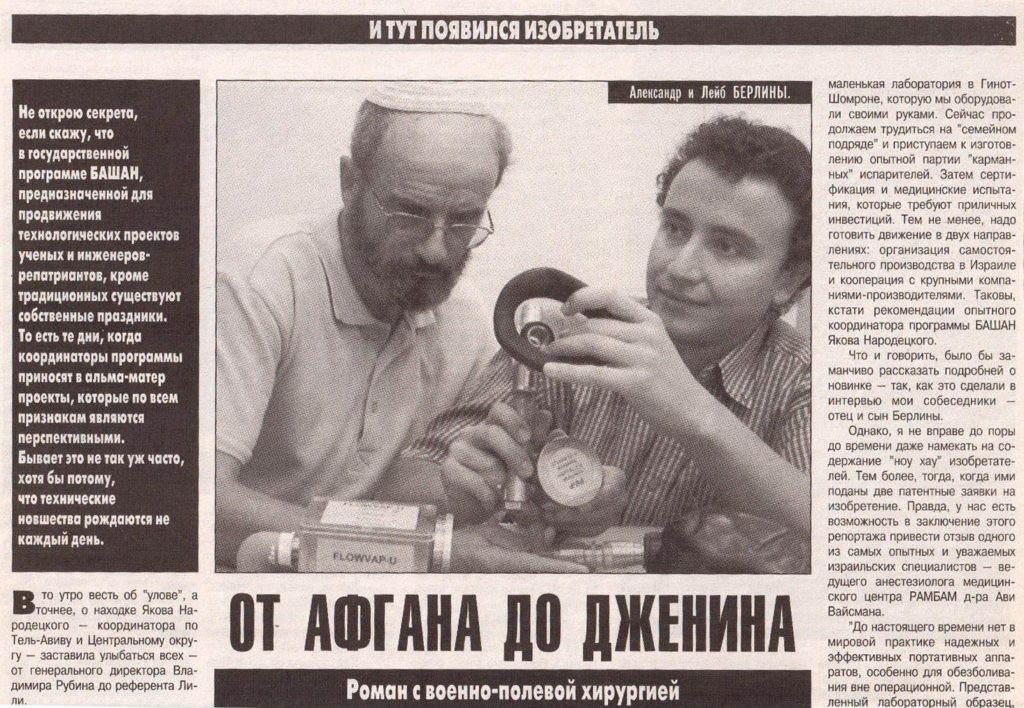
The second “evaporative” series began 20 years later, in 2000, when my son Leib, Viktor Mazin, and I were awarded a public-private grant in Israel through LaminarTechnology Ltd.
We set up a laboratory in a small room, and a couple of years later, on our fifth attempt, we arrived at the “MINIVAP-20.”
At the end of the second series, there were interesting trips to Germany (Drager) and England (Penlon) – we dreamed of collaboration.
The second series practically ended in 2005 in the face of prohibitive (over $1 million) technical and medical testing.
2005 - 2013
But then the renowned Russian anesthesiologist, Professor Nikolai Evgenievich Burov, came to their aid. He first breathed through the new vaporizer himself and then showed it to Russia’s chief anesthesiologist, Professor Igor Vladimirovich Molchanov, in the adjacent office at Botkin Hospital (see I.V. Molchanov’s report in the “REVIEWS” section).
Understandably, the process of state technical and medical testing dragged on for almost five years. It began with the assistance of Alexey Alexandrovich Svitsov, CEO of the membrane company “NPF TEKO” (based at the D.I. Mendeleyev Moscow Chemical Technology Institute), and was successfully completed thanks to financial support from the State Innovation Fund in 2009.
A year later, the “iron and jet-powered” I.K. Gorlin (See the “Participants” section for more details), whom I spent three years persuading, obtained state registration and certification for the Anesthesia Machine “Colibri” and MINIVAP evaporators (an impossible task even for a persistent “artisan”).
At the same time, in 2010, Boris Samuilovich Yakubovich, CEO of TSENTRKONTROLAVTOMATIKA, agreed to first manufacture pilot samples of the MINIVAP-20 evaporators, and then a production batch, in the experimental workshop of JSC Aviamotor Scientific and Technical Complex “Soyuz” (CEO Lev Nikolaevich Shvedov).
Three relatively complex technological challenges needed to be solved with minimal expense: manufacturing a thin-walled housing, distribution device components (valve system) with relatively high precision (±10 µm), and final volumetric brazing of the stainless steel housing components. These tasks were professionally and enthusiastically addressed by the experimental workshop team (headed by Viktor Ivanovich Sizov), who had the necessary equipment.
During 2011, during the second stage of the state contract with the Foundation, new models of portable Anesthesia Machine “Colibri” based on the MINIVAP-20 vaporizer were tested at Bely Klyk, the largest chain of veterinary clinics (Head of Anesthesiology A. Yu. Pavlyuchenko, PhD E. V. Skachenko – see the Abstract in the “Reviews” section).
Thus, we identified a promising market niche for mini-devices. The minimum parameters of our devices are precisely suited to the main patient population (dogs, cats, mice, birds).
Key objectives by the end of 2013:
– Manufacture and test the most powerful MINIVAP-200 vaporizers available; this, combined with the smallest MINIVAP-20 vaporizer, will cover the required ranges of anesthetic concentrations and gas flow rates;
– Establish a foothold in pediatric dentistry (several units have been purchased and are in use in dental clinics);
– Manufacture MINIVAP vaporizers from non-magnetic materials (copper alloys) and test them in MRI at maximum magnetic field strength (in veterinary medicine, stainless steel MINIVAP-20 vaporizers are successfully used, but at limited magnetic field strength);
– Test Anesthesia Machine “Colibri” in emergency situations, first aid, and military field conditions.
Extract "sparks" from all sides
A happy ending to this story could be the normal mass production of mini-vaporizers (for example, as at Penlon and Drager, or even as in the “Soviet” 1980s), of course, with the involvement of powerful and professional resources.
P.S. A few more components of the “MINIVAP” development process need to be added (a couple of illustrations can be found on the English version of the COOPERATION website).
About 50-60 years ago, low-resistance vaporizers (“drawover” – gas is inhaled through the vaporizer) dominated inhalation anesthesia, but were later supplanted by more precise high-resistance vaporizers (“plenum” – gas passes under pressure 100 times greater than that experienced during inhalation). At the turn of the millennium, the renowned anesthesiologist Nunn GF posed a challenging question: “Why did drawover anesthesia stop?” despite its important advantages (independence from high-pressure gas sources and rapid control of anesthesia depth).
Therefore, it was natural to want to solve a “precise problem”: to create an evaporator with a stable concentration without exceeding the permissible breathing resistance (during anesthesia, approximately 100 Pa (10 mm H2O) at a gas flow rate of 10 l/min).
It’s a jewelry design because, at low resistance (e.g., 5-10 Pa at a gas flow rate of ≤ 2 l/min – low-flow anesthesia), secondary disturbances (pressure and temperature fluctuations, density variations (sevoflurane vapor is 7 times heavier than air) are comparable in magnitude to the control parameter (resistance or pressure drop) of the vaporizer’s concentration regulator (gas valve).
The “Anestezist-2” vaporizer, adopted for military use back in the 1970s, featured the main components of a stabilized low-resistance vaporizer: a direct-flow concentration regulator and an evaporation chamber with slotted channels (analogous to the human respiratory tract and the mass-exchange system of fish), which distinguished it from well-known foreign analogs at low gas flow rates (< 3-4 l/min).
However, at lower flow rates (≤ 1 l/min), this stability was also disrupted. Due to the difference in vapor density between the anesthetic and gas.
Despite the very small scale and significance of our products, one can still ask the question, “How did it work?”
In 2000, we attempted to continue our unsuccessful attempts at designing evaporators without an independent concentration regulator (we made five experimental prototypes, and secured the same number of copyrights and patents).
At the same time, we continued the conceptually old (but practical) “Anestezist-2” design with radical modifications:
– horizontal orientation of the concentration regulator with its level aligned with the evaporation chamber (the minimum gas flow rate became 0.2 l/min instead of 2 l/min);
– miniaturization;
– coolant with a “liquid ↔ solid” phase transition (first unsuccessful attempts with glycerin, which, according to the reference book, has a melting point of 18°C), then “paraffin” traces on the internet and contacts with dealers of foreign companies, and finally, Borya Reiderman and his friend Mikhail Mitrofanov found the necessary paraffin in 2010.
In 2011 alone, they managed to increase the sevoflurane concentration in the MINIVAP-20 by almost 1.5 to 2 times, to 6% (in response to valid comments from anesthesiologists at Filatov Hospital and Lina Vladimirovna Soboleva, Head of the Anesthesiology and Resuscitation Department at the Dental Center), by equalizing the resistance across the entire concentration range and “licking” the evaporation chamber (combatting gas flow and flowing around the evaporation surfaces).
At the same time, they reached 15% sevoflurane by volume in the MINIVAP-200 evaporator, guided by the inspiring words of V.V. Subbotin, Head of Anesthesiology and Resuscitation at the Vishnevsky Institute of Surgery.
As always, ≥90% of the time is rough work (trial and error). Even the greats Pushkin, Tolstoy, and Babel threw 10 pages in the trash and only the 11th was published.
On the other hand, when asked, “Is it difficult to write?” Akhmatova replied, “What’s difficult when they dictate?” even though the official Prophecy ceased 2,000 years ago.
It resembles the Brownian motion of molecules with socio-technical barriers, milestones (see COOPERATION anesthesiologists, plus the monitoring of the heads of anesthesiology and intensive care, Yeshua Katz and Dr. Avi Weissman, at RAMBAM Hospital, Israel, tips from the turning grandmaster Yakov of MAYA, Haifa, etc.), and ideological tuning forks.
World standards, the best analogs, and methods have become accessible via the internet even without a thorough knowledge of the language (open an online dictionary). The problem of civilization has been solved—one language (for more details, see Zamir Cohen’s lectures).
It is possible take the best, extract “sparks” (R. Cook) from all sides.